| Hong Kong Movie Reviews Menu |
Infernal Affairs 2
Buy this film!
| Rating: | 7/10 |
| Year: | 2003 |
| Genre: | Detective Thriller |
| Director: | Andrew Lau, Alan Mak |
| Cast: | Eric Tsang, Anthony Wong, Shawn Yue, Edison Chen, Hu Jun, Carina Lau |
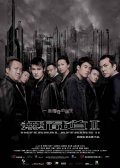
(Beware of minor spoilers, read at your own risk...)
Producing a trilogy movie within a year is perhaps a herculean task or even an impossible mission for Hollywood filmmakers, but in a fast-paced city like Hong Kong, nothing seems to be impossible. Last year in 2002, Infernal Affairs smashed the box office record and became the highest grossing domestic film of the year. Not long after that, at the end of this year (2003), the last episode of this trilogy was already released in early December, while the second one, Infernal Affairs 2, came out earlier this year in the fall and did fairly well at the box office.
Despite the slightly misleading title, this second installment of the series is actually not the sequel of Infernal Affairs, but the prequel. The story harks back to about ten years before the first movie when Wong (Anthony Wong) and Sam (Eric Tsang) are once good friends. They, together with Hau (Francis Ng), the boss of the mafia family, are the focus of the movie, while the original lead in the first movie, Yan (Shawn Yue) and Ming (Edison Chen), the young version of Tony Leung and Andy Lau respectively, are placed at a subordinate position this time.
As the story is quite complicated and each part is closely linked together, it doesn't seem like a wise idea for me to do a plot summary that will likely contain tons of spoilers. Having said that, my feeling toward this movie is quite mixed. If you consider it as a separated piece of work from the rest of the trilogy, it is definitely not a disappointing job. Although the movie was made in a rush, the overall quality doesn't deteriorate that much. No matter the camera angle, setting, the structure of the plot, the complex delineation of the characters as well as the direction, everything is top-notch. Nonetheless, considering it as the prequel of IA, the collapse of the plot continuity is rather distracting. This lack of consistency is especially obvious among some characters, that is, some of their personalities are changed so enormously that you would wonder if they are the same persons. For instance, in IA, Wong is supposed to be a responsible and brilliant officer who strictly believes in discipline and justice, but in this movie, he is no longer an absolutely positive and heroic character, we can easily feel the evil side of him from what he does. No doubt this mixture of good and evil makes his character much more captivating and genuine, but at the same time, it just totally destroys the continuity of his role in the trilogy. Another character that is radically altered is Yan (Shawn Yue). In the first film, we are given the impression that Yan and Wong are just like father and son and their bond is very close; but in this movie, Yan doesn't really treat Wong as a friend or father, especially when he knows that Wong is the one who kills two of his closest family member (directly and indirectly). Their relationship actually turns negative at the end. Another inconsistent plothole is that if Sam clearly knows that Yan is Hau's brother and that Yan is aware of his betrayal against his brother, considering Sam's wit and cunning character, why would he want to assign such a time bomb as his right-hand man? And if the Thai guy is so ruthless, why doesn't he also kill Keung (Chapman To) when he attempts to murder Sam? Perhaps one or two of these plotholes will not mean much, but when these minor errors add up together, it just makes you hard to connect everything from both films and view it as a whole.
Anthony Wong and Eric Tsang, taking the lead roles, are remarkable as usual. Their characters are well developed and the psychological changes are more apparent than the previous film. Francis Ng as the stony face mafia boss is a surprisingly good fit. Although this kind of character is nothing new as it has almost been depleted by a lot of detective thrillers movies already, Ng's engaging performance still allows him to steal the show from the rest of the actors. The almost dialogue-free Roy Cheung and Liu Kai-chi are also impressive. The two of them rarely talk but their postures alone already bring out the uniqueness of their characters. Talking about Yan and Ming, the supposedly major characters of this series, it is certainly meaningless to compare Shawn Yue and Edison Chen with Tony Leung and Andy Lau, but you can feel how much effort they have spent on imitating their predecessors.
To sum it up, Infernal Affairs 2 isn't as good as the first one, but it is still worth the ticket. If you are a fan of Infernal Affairs, you'll probably like Infernal Affairs 2 too, despite the continuity problem; If you are not a fan or haven't seen the first one before, you'll probably like it more!
Reviewed by: Kantorates