| Hong Kong Movie Reviews Menu |
Eros
Buy this film!
| Rating: | N/A |
| Year: | 2005 |
| Genre: | Romance |
| Director: | Wong Kar Wai, Steven Soderbergh, Michelangelo Antonioni |
| Cast: | Gong Li, Chang Chen, Robert Downey Jr., Alan Arkin, Christopher Buchholz, Regina Nemni |
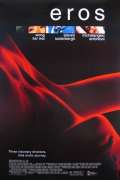
Eros is composed of three short movies respectively directed by Hong
Kong filmmaker Wong Kar Wai, American director Steven Soderbergh and Italian
master Michelangelo Antonioni. The structure of the film is similar to Peter
Chan's Three, but with a shift of emphasis from the genre of horror
to sex and romance.
The movie begins with Wong's The Hand, and is followed by Soderbergh's Equilibrium and Antonioni's The Dangerous Thread of Things. Each of these stories is very simple and direct. The Hand is about the forbidden affair between a young tailor (Chang Chen) and an elegant courtesan (Gong Li); Equilibrium explores the distinction between dream and reality through a psychotherapy between an advertising executive (Robert Downey Jr.) and a psychiatrist (Alan Arkin); The Dangerous Thread of Things depicts a rotten marital relationship between an American man (Christopher Buchhoz) and her Italian wife (Regina Nemni).
Despite my perpetual love in Asian cinema, I have to admit that I still regard Wong Kar Wai's The Hand as the most accomplished and successful short among the three. This short movie inherits Wong's everlasting passion and affection for the 60s of Hong Kong. The overall aesthetic and cinematic choice are identical to that of Days of Being Wild, In the Mood for Love and 2046. From the beautiful costume to the nostalgic setting, and from the trademarked alluring atmosphere to the sophisticated framing, everything is purely "Wong Kar Wai". Nevertheless, compared to its aesthetic, what makes this movie a real stand-out is actually the emotions it generates. Once again, Wong succeeds in delineating a very eastern and traditional love pursuing approach of Chinese people. The quiescence of the never really blossomed love between Chang (Chang Chen) and Hua (Gong Li) is elaborated by their seemingly closed yet distant dialogues and interaction. Apart from the "handjob" in the beginning, Chang and Hua never really approach each other further, the most Chang does is merely playing with the "qipau" (Chinese dress) of Hua in his little seaming room. In this scene, Wong Kar Wai accurately and convincingly visualizes the repressed mind of the character who is engaging in a forbidden affair. Emotion and feeling are deeply suppressed. To me, it is not only the most memorable and moving scene in the entire Eros, but it is also as unforgettable as Tony Leung's murmuring to the cave in In the Mood for Love. (8/10)
Among the three shorts, Soderbergh's Equilibrium is perhaps the one that is most elusive and confusing. The structure of the "dream inside another dream" is no doubt quite inventive, and the highly comical performance of Alan Arkin is also worth noting, but unfortunately, this entire story just seems to be heading to nowhere after all. It is a highly experimental work, which in its own sense, is perhaps inspiring and interesting, but if viewed as a whole with the rest of the Eros's pieces, is quite irrelevant and aimless. (5/10)
Despite his established status and strong reputation as one of the most important filmmaking masters of Italy, Michelangelo Antonioni's The Dangerous Thread of Things brings nothing but disappointment to the audience. The story of the movie is dry and tedious. Other than exhibiting the not so captivating landscapes and nude bodies of her actresses, it just seems that Antonioni is running out of idea to actually express his thoughts or further explore the subject matter. (4/10)
Perhaps I was anticipating quite a lot from the three renowned filmmakers, I was quite disappointed by the overall outcome of Eros. Now that we have the horror and romance three in one, so what is next?
Reviewed by: Kantorates