| Beyond Hong Kong Movie Reviews Menu |
Tokyo Sonata
| Rating: | 9/10 |
| Year: | 2008 |
| Genre: | Drama |
| Director: | Kiyoshi Kurosawa |
| Cast: | Teruyuki Kagawa, Kyoko Koizumi, Yu Koyanagi, Inowaki Kai, Haruka Igawa |
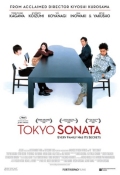
Best known as a horror film master, Japanese filmmaker Kiyoshi Kurosawa is
actually good at handling different genres. In 2008, his shomingeki (family
drama) Tokyo Sonata had stunned the audience at Cannes Film Festival
and won the grand jury award. The film was so well received that when it
traveled back to Asia, it also managed to capture highest honored Best Film
award at the Asian Film Award ceremony in Hong Kong.
Set in modern Japan, the film focuses on a small family struggling under the difficult economic time. One day, Ryuhei Sasaki (Teruyuki Kagawa), the father of this family, is laid off. Too shamed to inform his wife and sons, Ryuhei pretends to go to work every day and wanders around the city, where he later comes across another friend who has similar fate. His two sons are both obscured about their future, one has made a strange decision of volunteering for the US army and head to Iraq, another has discovered his own talent haphazardly...
Shomingeki refers to family drama in Japan. This kind of movie usually deals with the ordinary class (as opposed to the upper class), depicting their mundane life and their happiness or sadness. In the history of Japanese cinema, Yasujiro Ozu and Mikio Naruse are the two pivotal directors known as the master of shomingeki. Apparently, Kiyoshi Kurosawa's Tokyo Sonata shares a lot of similarities with Ozu's films. For instance, just like Ozu's Tokyo Story and Tokyo Twilight, the film title consists of a physical location, "Tokyo"; Both feature a nuclear family that seems to work properly superficially but instead malfunctions internally; Both maintain a low camera angle and flat composition in indoor scenes, etc.. However, when the film progresses, Kurosawa does bring in a little more variation and show his own style by shifting the story from a mundane world to something quite surrealistic, which reminds the audience very well of his horror film.
Before the whimsical break-in scene near the end, the story follows a tangible path and delineates the change of the protagonist (that is, Ryuhei the father) delicately, from the moment he gets laid off, and then pretends to go to work, and gradually to the point when he finally faces the reality and opts for a career change. It also succeeds in bringing out the discrepant relationship of the family members through a series of terse yet powerful scenes and dialgoues. Although it is not laughing matter, the good thing that keeps the film entertaining is Kurosawa's appropriate decision to include quite some black humors to dissolve the miserable nature of the story. These humors are not forced but flows well with the narrative. He doesn't make his character look stupid, instead he lets us understand that it is the social situation and the malfunctioning of the system that causes the embarrassment. Moreover, Kurosawa seems to believe in hope and attempts to convey a positive message to the audience. Through the surreal revelation in the end, everyone in the family gets a chance to be reborn and returns to embrace the many facets of life.
Technically speaking, Kurosawa maintains his favorite use of long shots, the visual and editing are clean and the characters are also very well presented. Teruyuki Kagawa as the father is superb. Without a handsome and glamorous appearance, it actually helps Kagawa to deliver some convincing performance as an ordinary head of household. Kyoko Koizumi, once a teen idol in the early 80s, has successfully transformed herself into a versatile actress. Her role as the mother is perhaps less conspicuous, but it does play a crucial part in the film. The two sons played by Yu Koyanagi and Inowaki Kai are also interesting. Kurosawa's regular actor Koji Yakusho makes a cameo in the film. He plays a funny role this time, which is quite different from what he has done before, yet it just seems a misfit as compared to the other characters in the film.
Along with All Around Us and Still Walking, Tokyo Sonata is another well executed family drama that conveys genuine and believable human emotions, and it is perhaps one of the best films from Japan last year (2008). It is also an excellent example that shows that a good film doesn't necessarily need a big budget with slick effects to appeal.
Cool guy(s) - The entire cast
Reviewed by: Kantorates