| Beyond Hong Kong Movie Reviews Menu |
Pillow Book, The
| Rating: | 8/10 |
| Year: | 1996 |
| Genre: | Drama |
| Director: | Peter Greenaway |
| Cast: | Vivian Wu, Ken Ogata, Ewan McGregor, Yoshi Oida, Hideko Yoshida, Judy Ongg |
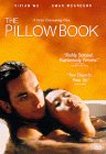
The Pillow Book is a drama and very much an art film. Vivian Wu, the protagonist, is
taught from a very young age to appreciate the art of calligraphy, writing and reading by
her father and mother. As a small child, her father, a writer, would tell her stories and
paint little symbols on her. Her mother would read The Pillow Book to her every night
before she went to bed, which is a story book that was written nearly 1000 years ago.
As an adult Vivian Wu, the protagonist, has grown up and become obsessed with reading and doing her writings on the skin of people. She loves to be written on as well. Her obsession to write is also tied in with her sexual obsessions. To her the perfect lover is a man that is a good Calligrapher as well as a good lover. In fact, she was so obsessed with the idea of being written on, that she left her first husband because he did not share this obsession with her.
After leaving her husband, from a pre-arranged marriage as a fairly young girl, she sets out into the world on her own. Because of the shame of leaving her husband she lives a life in hiding from her family until she transitions into a fast paced, high fashioned life with all kinds of bizarre experiences.
Her obsession to write leads her on a search for a Publisher and in the process finds the love of her life which then ends in another tragic love affair. She does however, find what she if looking for in this lover (Ewan McGregor). He is also a writer and they spend the next several months together making love and painting on each other. Her original intent was to use him to get to his Publisher which in the end he is more than glad to do.
There is a lot of tasteful nudity, heterosexual love making and sybolism in this film. There is also a fair amount of homosexuality in this film. Eventually, the protagonist is writing calligraphy on many different men depending on the quality of their skin and if it is just the right kind of skin for her to work on. Eventually we see so many nude men that quite frankly, it is more than I would care to see. However, it made an artistic point which portrayed her obsession very well, for purposes of telling this story. As her obsession to write grows, the more nude men we see.
To me this was an odd obsession. In fact, if there is one complaint I have of this film it is that I got tired of Vivian Wu painting on everyone. It was almost like watching pornography after a while and at times it became boring to watch and I wanted the movie to move along. As her obsession grew, the more she looked for people to write on. While it was appropriate to the story, by the end of the film she was writing on everyone, but for a reason we later come to discover. It seemed that she had become famous and people were coming to her to have her books written on them. Each completed person was a complete book. She was very particular about the type of skin and was it good or bad for her calligraphy.
Calligraphy was photographed a lot in this film. Her (Vivian Wu's) stories got more and more elaborate and all the bodies she painted on where closely photographed. They really were works of art. In the closing credits there was at least 15 calligraphers listed. These were not tattoos. These drawings came off in the water. In fact there is a shower scene where Vivian Wu stands and lets the water wash all of the paint off of her. I would have thought that after a while that all that paint would eventually stain her skin. I mean in real life if someone was painting themselves every day, that in reality you would become permanently stained. As I said, it was an odd obsession, but the director did a good job of showing it. I would think very few people in the world would have an obsession such as this one.
The set had a very sophistocated detailed look to it. The use of music was very good in this film. The musical score was quite noticeable in this film as opposed to some films where you don't notice the music at all. The music always set the mood for each scene, and helped to tell us how we were supposed to be experiencing the scene. Whether it was a love scene, or a tragic scene, etc. Sometimes they would go from a tragic scene and completely change the music to a light funny tune to snap you back to reality and onto the next scene.
The use of photography was excellent. There was a lot of use of split screens and backgrounds with a smaller screen in the middle to tell a story within the story or to do a flash back. The only problem with some of the backgrounds when they did this was that they might have a light background with light subtitles. Those subtitles were hard to read but for the rest of the movie, whenever there was a normal scene the subtitles were easy to read.
There was also the use of black and white versus color photography. Black and white photography was used when the protagonist (Vivian Wu) was a young child and for scenes portrayed in her past. All of her adult life was phographed in color. Sometimes there would be a touch of color in the black and white scenes, which sparingly used is always effective.
The various plots and subplots in this film all tie neatly together in the end of the film. Also in the end she is able through her own life experience to write her own Pillow Book. The script was very sophisticated and somewhat erotic. This film was beautifully directed, filmed and well acted. Ewan McGregor was very good as Vivian Wu's lover. But this isn't a light hearted film. It is very much on the serious side. It is one of those films that lingers on in your mind a couple of days after you have watched it.
There is some English speaking in the film but most of the film is in Japanese with subtitles. I had no trouble following the flow of the story even though it kept going back and forth from English to Japanese. In fact, after a while when they were speaking Japanese I didn't even need the subtitles because the visuals were so good. A lot of the story was told with visuals and music.
I liked this film. It was quite unusual compared to anything else I have seen. Very artistic and thought provoking.
Reviewed by: Barbara Friedman