| Beyond Hong Kong Movie Reviews Menu |
Peace
| Rating: | 7/10 |
| Year: | 2010 |
| Genre: | Documentary |
| Director: | Kazuhiro Soda |
| Cast: | Toshio and Hiroko Kashiwagi |
Documentary has long been a forgotten field in mainstream Asian cinema. It's not
until recent years that we see a growing number of quality documentary features
produced by Asian filmmakers. While most of the spotlights go to Chinese filmmakers,
for instance, the European-favored Chinese glory Jia Zhang-ke and Oscar winner Ruby
Yang, Japanese filmmaker Kazuhiro Soda nevertheless is making a quiet revolution by
exemplifying through his films that Japan is not left behind in the realm of documentary.
As a faithful disciple of the school of Cinema Verite, Kazuhiro Soda's feature length documentary debut Campaign in 2008 shows his audience the power of his observational lens and how fragments of image can be organized to provoke thoughts and meaning. His following project Mental again became an international film festival favorite. In 2010, he made Peace, a smaller (compared to his two previous film) yet equally sophisticated and mind provoking documentary that explores the idea of peace and coexistence in his signature observational approach.
Hailed as a master of observational documentary, Soda's technique is actually quite different from the school of direct cinema. While both share the same goal of capturing reality and representing it truthfully without inserting explicit comments of the filmmakers, Soda never opposes the idea of making his subjects aware of the camera's presence. Throughout Peace, we can hear him interacting with his father and mother-in-law. Another subject Shiro Hashimoto is also constantly reminded of the existence of the camera, and even purposely dresses up a bit in order to look good on screen.
As Soda revealed in his director's statement, whenever he works on a project, even though there may be a theme (Peace was commissioned by a film festival), he never tries to build up preconceptions on his topics. Unlike most documentary or narrative productions that rely heavily on research and discussion, he always prohibits himself from spending too much time on pre-production. His films are always about the shooting process and editing. It is in the editing room when he begins to formulate his ideas and decide how to fill in the gaps of the big puzzle.
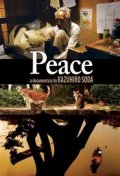
While Soda's freestyle approach may lead to a collection of interesting images and unexpected outcome, which in his words is usually exciting and insightful, it also poses the risk of disorientation. That is why at first glance, Peace seems to have a lack of focus on its subject matter. In the beginning, we only see Mr. Kashiwagi feeding his cats, and then we follow the daily routine of his life as a welfare taxi driver; A moment later, the camera shifts to Mrs. Kashiwagi and her visit to Mr. Hashimoto, an old man who is receiving hospice care. The remaining film then revolves around the charity work of the Kashiwagis and finally wraps up at when it begins, the backyard of Mr. Kashiwagi and the cats.
While most of the events in the film look mundane, what makes the film interesting is how Soda managed to choose the appropriate footage that brilliantly responds to his theme of peace and coexistence. First, through the battle of the cats' territory, it questions the process of coexistence in nature. Second, the struggle of Kashiwagi's charity works explores the social position of elderly population in our society. In this part, three perspectives are included, 1) the amount of support by government defines the social value of elderly acknowledged and mutually agreed by the mainstream society, 2) the difficulties of the charity workers reflect the difference of the real need of the elderly and the aforementioned defined value, and 3) the interview with Mr. Hashimoto displays how the elderly value their own existence and how they consider themselves as social burden.
As usual, Kazuhiro Soda doesn't really offer a concrete answer to any of the questions he raises in the film. Yet he does open a doorway for the audiences to contemplate and interpret the issues on their own. It is the kind of film that prohibits preaching a message but actively invites the participation and interaction from its viewers.
Perhaps Kazuhrio Soda's film is a little rough and the structure looks spontaneous, he is nevertheless one of the more promising documentary filmmakers from Japan following the success of Kazuo Hara in the late 80s. Fans of Japanese documentary should definitely not miss it. Peace is screened at 2011's San Francisco International Asian American Film Festival.
Reviewed by: Kantorates