| Beyond Hong Kong Movie Reviews Menu |
Little Monk, The
Buy this film!
| Rating: | 6/10 |
| Year: | 2003 |
| Genre: | Drama |
| Director: | Joo Kyung-jung |
| Cast: | Kim Tae-jin, Kim Min-kyo, Oh Young-soo, Kim Ye-ryung |
Without doubt Korean audiences are becoming more and more receptive these years. Many
non-mainstream movies have been doing well in the commercial film market. For instance, in 2002,
films like The Way Home, Bad Guy, Chihwaseon, Oasis and Sympathy
For Mr. Vengeance all lean at least partly toward the art-house route, but they were
still generally welcome by the audience. The Way Home did even manage to capture
the 1st runner up of the highest grossed domestic film of the year. Stepping into 2003,
the first of this type, The Little Monk (I would tend to categorize My Teacher
Mr. Kim as a mainstream movie that focuses on entertaining the audience), hit the
theater in April.
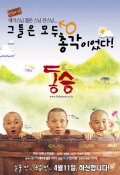
This film was shot in the secluded area far away from Seoul. Do-nyeom (Kim Tae-jin) is raised up in a Buddhist temple by the temple master (Oh Young-soo). As Do-nyeom is growing up, he begins to wonder about his mother. He hopes that one day his mother will come and take him away to live in the city. On the other hand, another young monk Jung-sim (Kim Min-kyo)'s mind is very confused. He is obssessed with sex. He always thinks about women... From the promotional poster, I first expected this film to be a light-hearted comedy, but it turned out to be a total opposite. The entire story is filled with grievance. All three of the monks have their own struggling problems. The two young monks have to choose between lust and religious training; while the temple master has a hard time communicating with his pupils and understanding what they have in mind. It seems that their lives are never joyful.
This film is adapted from a novel, and the script contains quite a lot of Buddhist quotes. To be honest, I don't have too much knowledge about Buddhism and the novel, therefore, I would simply interpret the meaning of the movie based on the story and the characters development. Looking at it from a broader perspective, it seems to reflect the relationship between the government and the citizens. The temple master is a representative of the government. He believes what he does to his apprentices is good for them. He is sometimes strict to them but sometimes indulgent. He truly thinks that the young monks will obey his orders in this way, but in fact he never really understands what they need. Apart from feeding them with food (which is symbolized by the spring water), he does not know what Do-nyeom and Jung-sim wants. He is not aware of the real intention of Jung-sim's request to circumcise, and he never realizes Do-nyeom is suffering from the insipid life in the temple. Comparatively speaking, the government always tries to promote policies in which they believe are beneficial to the public, but they do not know that sometimese these policies instead annoy the people, and sometimes, they even force them to escape from the society, which is similar to the ending of the two monks in this film.
Kim Tae-jin is a popular child actor in Korea. He has been in numerous films before. His role as Do-nyeom is satisfactory. His lively facial expressions and clear articulation of dialogues have brought life to this character. Kim Min-kyo as Jung-sim is also impressive. He really understands his character well and is able to elicit the right emotion at the right moment.
The Little Monk is an enlightening work. It leaves quite some room for the audience to contemplate. The only pity is that the director (It is the directorial debut of Joo Kyung-jung) seems to be little inexperienced. A lot of the scenes are carried out monotonously, which makes it little hard for mainstream audience to fully appreciate it. Nevertheless, it is still a charismatic film that is much more meaningful than most popcorn movies.
Reviewed by: Kantorates