| Beyond Hong Kong Movie Reviews Menu |
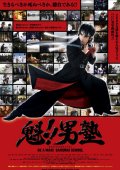
Be a Man! Samurai School
| Rating: | 7/10 |
| Year: | 2008 |
| Genre: | Action |
| Director: | Tak Sakaguchi |
| Cast: | Tak Sakaguchi, Shoei, Shintaro Yamada, Hiroyuki Onoue |
Manga adaptation is always a popular choice for Japanese filmmaker. The advancement
of computer technology has been a big booster for the blossom of this genre. In 2008,
many comics have become the subject of feature film, while most relied on heavy CG
effects to achieve their purpose, there are nevertheless some exceptions who led the
other way, Among those is Be A Man! Samurai School.
Adapted from a very popular Japanese comic in the 80s, Be A Man! Samurai School also marked the directorial debut of action star Tak Sakaguchi. Set in a time not far away from the end of WWII, it is a story about a group of high school students fighting for pride and power. The main setting is Otokojuku, a strange private boys school where most of the students look overage and ridiculously strong. To achieve success in this school, students must go through a series of harsh training by the drill instructors. Through the training, the students gradually become close and learn the true meaning of life.
Be A Man, one of the most popular comic series in Japan, was first published in the late 80s. It was a long-lived series and concluded its final chapter in the early 90s. Since the original story is quite long, first time director Sakaguchi, who also happens to be the screenwriter, just picked a short segment and put a heavy emphasis on a sidekick character Hidemaro Gokukoji (Hiroyuki Onoue). The protagonist of the original, Momotaro Tsurugi, played by Sakaguchi himself, has actually become a less pivotal character whose main function is merely to serve as a fighting machine.
Sakaguchi's decision isn't much of a surprise. Considering the heavy influence of imperialism in the original comic, which is certainly not a very welcome ideology in nowadays market, a shift of emphasis from loyalty to the country to friendship and masculine willpower is actually quite wise, and a more universal theme also helps secure a global market for the film.
Actor turned director Tak Sakaguchi started has career in a quite interesting way (according to some sources, he was spotted by director Ryuhei Kitamura during a street fight with some gangsters). As someone who began to learn his craft rather late and without prior knowledge on cinema, his debut as a director and screenwriter has absolutely earned him a passing grade. Although there are still a lot of errors here and there, for instance, some scenes don't seem to come together well, and the artistic choices of various elements are also questionable, the overall narrative structure works quite well, the use of special effects is moderately fit and the action choreography is also satisfactory.
One interesting observation about the narrative is its abrupt depiction of friendship between some characters. For instance, the male bond of Momotaro and Hidemaro is quite awkward. In some senses, the way they talk and interact just makes one wonder if there is any romantic relationship between the two. Though I believe it's not the intention of the filmmaker to show a seemingly homosexual relationship, and it is also against the original. Thinking about that, films that intend to exemplify intimate friendship of male characters always seem to suffer from such misinterpretation, take John Woo's The Killer as an example, throughout the years, quite some analytic articles have been pointing out the obscure relationship of the two lead characters and suggest some kind of romance between them.
To many comic fans, whether there is any homosexual notion in the film is certainly not their concern. What they really care is how well the film is able to capture the spirit of the original, and how accurate the characters look like their comic counterparts. Judging from these criteria, the answer is mixed. In the original, most of the characters have a different proportion from real-life human, they are all 6 to 7 feet tall, and their heads are rather small for a bulky and muscular body. So an absolute physical resemblance is out of the question. The director knew it and so he instead chose to focus more on the costumes. In terms of acting, Sakaguchi, who is capable of showing only a very small variation of facial expression and gesture, isn't really a good actor. But since most of the drama and comedy are left to the other actors, it isn't a big problem.
Among most of the manga turned feature, Be A Man! Samurai School is a lower budget yet entertaining adaptation. It is hard to say whether fans of the original would enjoy it, but for the general action and fantasy audience, it is without doubt a welcome effort by first time director Tak Sakaguchi.
(The film is an official selection of Another Hole in the Head Film Festival in San Francisco starting June 5th 2009.)
Reviewed by: Kantorates