| Beyond Hong Kong Movie Reviews Menu |
1980
Buy this film!
| Rating: | 7/10 |
| Year: | 2003 |
| Genre: | Comedy |
| Director: | Keralino Sandorovich |
| Cast: | Rie Tomosaka, Yu Aoi, Inuka Inuyama |
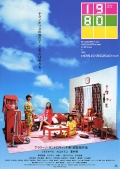
(Possible spoiler below)
A funny movie that centers on the Hachima family, a bad-luck father working as a School Principal living with his 3 daughters (each being senior than the immediate junior by 10 years) from his three deceased wives. The year was 1980 when the story began, a time when Japan was destined to overcome the 2nd Oil Crisis and then experience another round of rapid economic growth. There we have the eldest daughter, Kanae, aged 35 (born in 1945), the mid-daughter, Reiko, aged 25 (born in 1955), and the youngest daughter, Rika, aged 15 (born in 1965).
With the approaching of the 1980s, the 3 daughters were to face great challenges and changes that would affect their lives in the future. The eldest daughter, Kanae, as one of the immediate postwar baby boomers, had marriage problems and was bent on divorcing her husband. Her overly suspicipous attitude was actually the source of the triuble that tended to alienate her spouse. The second daughter, Reiko (Rie Tomosaka), grasped a chance to enter into the show business and became a second-rate TV actress with a little reputation as an aspiring idol but nothing more. However, her warm heart and weak character also led to her own astray and resulted in a complicated string of sexual relationships with any men with only shallow encounters. The stress led to her quitting from the show business and instead found sanctuary as a school teacher at her father's school. Rika (Yu Aoi), t he youngest daughter, a devotee to the school's Cinema Club, also had to make a choice as to whether to act naked in their club's first indie movie production. The movie ended with the ushering of the 1980s and Reiko turned round to her two sisters and asked them what would they have become twenty years from then (that is, by the end of the 20th century and the beginning of the 21st century). Of course, by then, the 3 daughters would each be at the age of 55, 45, and 35.
As the debut movie of Keralino Sandorovich, the movie glides rather smoothly and humorously into the social lives of the 3 daughters with gags basically reminding us of the good old days of the 1970s Japanese pop culture. The songs of YMO (Yellow Magic Orchestra) were widely used as a reminder of the coming of the techno-pop and a homage to Japan's first successful international pop band. All these tend to have some sort of a nolstagic touch on the good old years of the 1970s and the 1980s.
The personal problems faced by the three daughters by the end of 1980 have magnified in salience to symbolize something that's become more popularly felt by the mass majority since the 1980s: the marriage and divorce issues; the infantilization of J-pop idol celebrity; and the growing nihilism and directionlessness among young teens. It can be seen that the director has the ambition to tackle the changing women's issues in postwar Japan by imprinting the age marks of his actresses in such important years of 1945 (end of the WW2), 1955 (creation of the postwar LDP dominance & the establishment of the lifetime employment practice), and 1965 (the year immediately following the hosting of the Tokyo Olympics & the acceptance of the country into the OECD). Thus, the 3 daughters each represent 3 generations of Japanese young women in postwar Japan. However, the script fulfills not the director's purpose and I find only marginal success in terms of Reiko's experience as an idol-actress-turned-ordinary. The housewife Kanae and the high school student Rika could not deliver strong emotional resonance to me as per their personal problems. Esp. in the story of Rika (played by young star Yu Aoi from Gaichu and All About Lily Chou Chou), I found not particularly strong interest in sympathising with her plight (mostly not related to ijime or exam pressure). Thus said, Sandorovich does a good job in narrating the story of Reiko and her personal weaknesses against the social setting of the 1970s.
OTOH, the personal acquaitance of Sandorovich has led to very interesting moments when he constructs those behind-the-camera scenes or when he introduces us to the Beat Takeshi TV-talkshows and his many silly jokes. These are great funny moments.
All in all, this is a movie that should attract interest to those who love Rie Tomosaka or who want to get a glimpse of the J-pop of the 1970s-80s.
Cool guy(s) - Rie Tomosaka
Reviewed by: Sebastian Tse