| Beyond Hong Kong Movie Reviews Menu |
Visitor Q
Buy this film!
| Rating: | N/A |
| Year: | 2001 |
| Genre: | Drama |
| Director: | Takashi Miike |
| Cast: | Kenichi Endo, Fujiko, Shoko Nakahara, Shungiku |
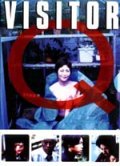
If you have never seen a Takashi Miike film, don't make this your first.
There is no cannibalism in this film. It has everything else though,
including things that I never imagined. I bought this movie because of
who directed it, and until that moment I never realized that I had a complete
and total lack of movies about incest, lactational-watersports and necrophilia.
This movie took care of all three in one fell swoop.
I was anticipating something faster and flasher, much more along the lines of Miike's brilliant yakuza films, Dead or Alive or Alive and City of Lost Souls. Visitor Q. is slow and almost sedate. Interestingly, this movie is fairly simple and straightforward compared to movies like Audition and the The Happiness of the Katakuris. I had to watch those movies several times (and if you've never seen Audition you can't imagine how hard that can be) before I felt that I had a grasp of what was going on. Visitor Q. is pretty simple: an angel comes to help a dysfunctional family get back together. That said, don't be fooled into complacency! Watch this move alone first, and then think long a nd hard on who you plan to show it to.
Visitor Q. examines a Japanese family with more problems than you can shake a stick at. The film opens with a scene about incest between a daughter (a prostitute) and her father in front of a home video camera. Incest is the first of many atrocious acts committed by this family. It just gets more bizarre from there. If the sole intent of the director was to shock the viewer with as many outlandish images as possible this film can be considered a success. However, I found this film to be totally lacking on a n emotional level. The family and there disturbing actions are presented in such a hollow way that the viewer does not feel any sympathy towards them. It would have been nice to see fragments of the family's past so we could answer the following questions: Has this family always been this way? If not, what led them to become these sick and twisted people? What is the purpose of them holding the video camera? Is that really an angel? Is it perhaps meant as a social commentary on the ever increasing absurdities of reality TV? Or a portrait of the changing dynamics of a Japanese society that has over the last couple of decades increasingly become attuned to the ways of the American models of entertainment and capitalism? It's open to our own interpretation, but, one thing is for sure, Miike never fails to shock or to challenge.
(* The film has a cheap snuff-film kind of look and I would not be surprised if Miike filmed it on an 8mm camera. In one scene a microphone and a stagehand are visible in a mirror. They are not hard to spot which annoyed me.)
Reviewed by: Kelly Kelley