| Beyond Hong Kong Movie Reviews Menu |
Tale Of Two Sisters, A
Buy this film!
| Rating: | 9/10 |
| Year: | 2003 |
| Genre: | Thriller |
| Director: | Kim Jee-woon |
| Cast: | Im Su-jeong, Moon Geun-young, Yum Jung-ah, Kim Gap-su |
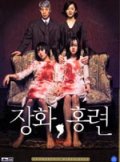
A Tale of Two Sisters by Korean director, Kim Jee-Woon is a deeply
psychological horror movie very much in the tradition of The Shining, The Sixth Sense
and Alfred Hitchcock's best work where the basis of the horror is almost entirely in the
mind of either the victim (The Sixth Sense) or the perp (The Shining). This
is not to say there is no suggestion of supernatural agent, but this agent is very much in
the background, pulling the strings of the deranged / possessed human agent.
The $64 question about this movie is whether the unraveling of the story is gloriously subtle or simply obscure. Before answering that question, I will affirm that the director and his technical support crew went to great lengths in their blocking and framing shots to achieve exactly the effect they wanted to come across on the screen. Even so mundane a detail as the wallpaper on the set representing the interior of the family house is done with great care, to the point where they were even proud of the fact that the wallpaper featured in the title sequence was based on an English 19th century William Morris design. The evidence of the care taken in laying out the movie is mostly in the numerous commentaries and 'making of' features among the extras.
A Tale of Two Sisters is a rarity among horror films that combines genuine human drama with spookiness. And it goes one better in presenting the audience with a multi-layered mystery that reveals itself gradually. Teenaged Su-mi (Im Su-jeong) and her younger sister Su-yeon (Moon Geun-young) return home to their father and stepmother after a stay at a mental hospital. Su-mi is outspoken, resentful of her stepmother, and always protective of the more reserved Su-yeon. Shortly after the girls arrive, strange things begin to happen around the house. Su-mi is plagued by horrific nightmares that may or may not be real. Objects seem to replicate themselves. Images of people appear and disappear. Their stepmother (Yum Jung-ah) blames the girls and then the house. Su-mi blames her stepmother. Their father (Kim Gap-su) blames everyone's inability to adjust to their new circumstances. Events from the past which are alluded to but never explained may hold the answer. Or is an otherworldly presence at work?
It's not surprising that A Tale of Two Sisters owes much of its success to its credibility. The relationships of these people - the resentful and protective older sister, the concerned but frustrated father, the cold and jealous stepmother- are in the forefront of the narrative, not secondary to the horror. Deep-seated emotions drive the characters, not fear. Unlike most horror or mystery films, we understand less of what's going on than the characters do. Writer/director Kim Ji-woon keeps the audience in the dark until nearly the end of the film. Since these are credible characters, we want to understand what's happening to them, and that sustains our interest. Layers of the mystery are peeled away gradually, revealing a genuine human tragedy with horrific implications.
A Tale of Two Sisters will appeal to fans of psychological thrillers as well as horror. I found the film more gripping than frightening. It has a story to tell -rather than just creeping you out. Production values also seem pretty high. Fine cinematography beautifully contrasts the idyllic, bright countryside surrounding the family's lovely old home with its dark, oppressive interior. In Korean with English or Spanish subtitles.
The DVD (Tartan Video 2005): There are reportedly 2 versions of this Tartan DVD: a single disc that is rated R and a two-disc set that is unrated. I assume it's unrated only because the bonus material hasn't been rated. The disc I saw was the first disc of the 2-disc set. It includes a trailer and two audio commentaries (in Korean with subtitles). The first commentary is by writer/director Kim Jee-woon, director of photography Lee Mo-gae, and lighting director O Seung-chui. This is a scene-by-scene analysis of how the story, tone, and characters are expressed through photography and lighting, including framing, lighting design, and camera movements. It's quite a good commentary if you're interested in the filmmaking process. The second commentary is with writer/director Kim Jee-woon and the actresses who played the sisters, Im Su-jeong and Moon Geun-young. Kim gives further commentary about his decisions and intentions and prompts the actresses to comment on their performances.
Reviewed by: Kelly Kelley