| Beyond Hong Kong Movie Reviews Menu |
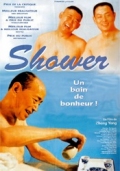
Shower
Buy this film!
| Rating: | 10/10 |
| Year: | 1999 |
| Genre: | Drama |
| Director: | Zhang Yang |
| Cast: | Pu Cun Xin, Jiang Wu, Zhu Xu |
I often felt troubled when people asked me to recommend some Chinese m
ovies, not because there weren't any good ones, but because those good
ones did not depict today's China. Some of Yimou Zhang's and Kaige Chen's
movies are not only good, but also, in my opinion, among the greatest ones
that the world has produced. However, the stories in those movies happened
many years ago; and these years are the ones that have seen the most dramatic
changes of a country in history.
My trouble ended with the introduction of Xizao (Shower) in North America.
The humors are Chinese styled, but the emotions are, as someone has said in his comment, universal. The values on intimate family relationships, genuine friendships, and concerns for the general public are exemplified in a society that is trying to find a balance between modernization and tradition. When economic development and new technologies menace thousand-year-old lifestyles, people, especially the elderly, become ambivalent towards them.
A country with an extraordinary history and tradition experiencing the most rapid development in the world, today's China can be a perfect set for many more good movies. I often wonder why there are so few movies like Xizao. As it has proved, you don't have to touch heavy politics to depict an authentic picture of today's China. (Kaige Chen's Together is disappointing.)
One of the commentators said the movie is uneven at some points. This is probably true, and unsurprising, given that the director is not as experienced as Zhang or Chen. However, I didn't notice the unevenness because I was captured by the actors' wonderful performances. You will be easily amused by Wu Jiang's performance as Er Ming; you would be more impressed by Xu Zhu's Master Liu and Cunxing Pu's Da Ming if you understand Chinese. These are the finest Chinese actors of their respective generations.
I noticed that some commentators thought the story happened in a small village. This is a misunderstanding. The set is actually Beijing. Although bathhouses like the one in the movie exist in many Chinese cities, you feel more amazed by the changes that China is experiencing when you know this story happened in a metropolis, right?
If you want to understand today's China, watch this movie. If you want to understand the China before and during the Cultural Revolution (1966 to 1976), you should check out Huozhe (To Live) and Ba Wang Bie Ji (Farewell My Concubine). Artistically, Xizao may not be a masterpiece compared to the latter two, but it is definitely worth watching. In today's world, movies as warm as this one remind us of the beauty of life.
Reviewed by: Kelly Kelley