| Beyond Hong Kong Movie Reviews Menu |
Great Yokai War, The
Buy this film!
| Rating: | 10/10 |
| Year: | 2005 |
| Genre: | Action |
| Director: | Takashi Miike |
| Cast: | Etsushi Toyokawa, Takashi Okamura, Chiaki Kuriyama |
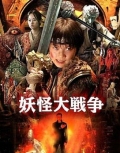
Yokai Daisenso (The Great Yokai War) was described as "a kids' movie from the guy
who made Ichi the Killer." I am a fan of movies that reinterpret Japanese folklore,
like Kwaida, Spirited Away and my favorite Studio Ghibli movie, Pom Poko.
Yokai Daisenso doesn't attempt to be as lyrical, profound, or eco-friendly as a Studio Ghibli film, nor as shocking as Miike's over-the-top action and horror movies. But it takes influences from both, as well as a thousand other sources, and ends up being an imaginative and entertaining action/comedy that parodies its influences at the same time it pays homage to them.
What's not immediately apparent in that plot synopsis is the wide range of influences that went into this movie. Miike's version is described as a remake of a 1968 film (which I haven't yet seen, but have on order) about monsters from Japanese folklore battling a European vampire. The ecological message of the movie will sound familiar to anyone who's seen a Studio Ghibli film, but it also has roots in Japanese folklore about tsukumogami - also, it doesn't take itself anywhere nearly as seriously as a Ghibli movie.
The yokai themselves are all taken from folklore, based on the interpretations of cartoonist Shigeru Mizuki (who served as a production consultant and is honored in the film by a sequence in which Tadashi visits a Mizuki museum to learn more about goblins). Most of the monsters are costumes and puppets - with some CGI, in particular for the rokurokubi - and come across as homages to Japanese super-hero monster series (as with Miike's Zebraman); Westerners are likely to see it as "Power Rangers" and "Ultraman" on a higher budget. Other creatures, like the Tanuki who head to Tokyo screaming "party! party!", are shown in their storefront statue incarnations instead of as "real" animals. And the mechanical monsters are created with stop-motion a nimation, making them seem unreal but familiar, as if they're paying homage not to folklore but to decades of science fiction movies.
When the film was first announced, it was hyped as "Japan's answer to The Lord of the Rings and the Harry Potter movies." It's not, but we don't see that as a failure on the part of the filmmakers - in fact, we have a hard time believing that anyone involved in the production of the movie took such claims seriously. What the movie does have in common with Peter Jackson's Lord of the Rings is that they're "big" stories told just for the sake of enjoying a "big" story, movies made by people who love the movies they grew up with.
The Great Yokai War is filled with product placement for Kirin Beer to the degree that it's actually a minor plot point, but it's done with scenes that parody the idea of product placement. The cute and lovable yokai that Tadashi befriends in the movie is exploited for all its family-friendly cuddly qualities, and also parodies the Pikachu phenomenon by being frequently beaten and tortured. (And still, it somehow doesn't come across as a shallow, predictable attempt to be Godzilla vs. Bambi-style "edgy"). Grandfather's quote about azuki beans parodies the idea of the wisdom of elders and reverence for tradition. A warning in the middle of Tadashi's plane flight makes fun of the fact that this is a "kid's movie." Much of the climactic finale is filmed in the style of a Japanese commercial. And the conclusion makes a surprisingly subtle comment about growing up and the loss of childhood wonder.
And in the end, it works. For all the grandeur and budget of movies like The Chronicles of Narnia or Harry Potter and the Goblet of Fire, they seem distant and ostentatious, too concerned with the dividing lines between spectacle, action, comic relief, and plot, instead of just relaxing and telling a fun story. The Great Yokai War is more proof that "family friendly" doesn't necessarily have to mean "safe, boring, and conventional." And it proved to us that we shouldn't judge a director's entire body of work based on one film; the only thing that Audition and The Great Yokai War have in common is that whether you love it or hate it, you won't forget it.
Reviewed by: Kelly Kelley