| Beyond Hong Kong Movie Reviews Menu |
Frozen
| Rating: | 9/10 |
| Year: | 1996 |
| Genre: | Drama |
| Director: | Wang Xiao-shuai |
| Cast: | Jia Hong-shen, Ma Xiao-qing, Bai Yu, Li Geng |
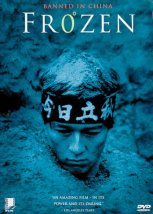
A member of a small group of intellectuals and artists, performs a series of
symbolic ritual suicides--burial by earth, water, and fire--on the first day
of each season, and plans to publicly end his life for good in a final ice
burial. Inspired by a real-life performance-art suicide (according to the
opening commentary), Frozen explores a rarely glimpsed youth subculture of
post-Tiananmen Square Beijing, and finds a mood of hopelessness. Wang
Xiaoshuai's deliberate direction and unadorned shooting style has won
accolades for its simplicity and directness, highlighted in two genuine
performance-art pieces: the first a stomach churning document of two men
eating a bar of soap, and the second the shivering ice burial. It's an
effective approach for those scenes, where self-torture becomes a desperate
grasp for sensation in a numbing existence, but elsewhere the anger and
frustration of the film dissipates in long, rambling discussions and a
meandering pace. Part of that style came from necessity: the guerrilla
production was shot in secret and smuggled out of the country. The director
finished it in Amsterdam and signed it "Wu Ming" (meaning "no one") out of
fear of reprisals from the Chinese government. In the years since its release,
Wang Xiaoshuai has come forth as the director, but the alias appropriately
remains on the prints. A film that gives voice to a generation of alienated
young adults desperate to be heard, it remains banned in China to this day.
VHS (US version) - I saw "Frozen" on VHS, rented from Blockbuster, the subtitles were good, the quality of picture was good (tape), I assume that a DVD would be better. My only reservation about Blockbuster is , when I was in film school our editing teachers told us not to rent from BB because they edit films and censor for content. I usually do not like to promote them when possible.
Reviewed by: Kelly Kelley