| Beyond Hong Kong Movie Reviews Menu |
24 City
| Rating: | 6/10 |
| Year: | 2008 |
| Genre: | Drama |
| Director: | Jia Zhang-ke |
| Cast: | Joan Chen, Lu li-ping, Zhao Tao, Chan Jian-bin |
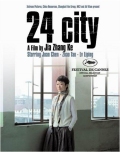
As a master of realist cinema, internationally renowned Chinese director Zhang Jia-ke
already demonstrated his ability to dexterously tackle narrative and documentary through
his various works, including Platform, The World, Still Life,
Dong and Still Life and some more. What if he blends the two totally
different genres together? 24 City, his sixth narrative feature film previously
premiered at Cannes Film Festival in 2008, seems to provide the answer.
24 City is a totally different experience for both Jia Zhang-ke as well as his loyal audience. This time, Jia departs from his hometown Shanxi and sets his story in Chengdu, focusing his attention on the history and change of an old factory. Established in the 1950s, military factory 420 itself was a miniature of the Chinese society, it was a witness of the growth and struggle of New china. Spanning a history of more than 50 years, the factory was at last purchased by a private developer and was rebuilt as a new housing complex named "24 City". The namesake film provides an accurate and vivid account of the history of 420, mainly through a mixture of interviews with some real and some disguised workers (performed by famous actors) from various era.
Incorporated with the characteristics of narrative and documentary, it is hard to define what kind of film 24 City is. While the subject matter of the 420 factory is factual, and Jia Zhang-ke did indeed spend almost a year to survey and interview with dozens of workers, what makes it a little controversial is that he also decided to employ some actors to play the role of the workers. Jia places these actors into real setting and treats them as real workers for his interviews. Partly real and partly staged, the boundary of reality and fiction is blurred.
Films that combine narrative and documentary approaches are not really uncommon. Take Taiwanese director Hou Hsiao-hsien's masterpiece The Puppetmaster as an example, it also employs a narrative strategy that mixes staged scene and interviews with its subject. One merit of Hou though is that he not only uses it as a narrative approach, but also, through this highly experimental device, tries to explore the principle of realist cinema, and further questions the authenticity of documented history. The result is a much more immersed and profound study of cinema as a communication and documentary apparatus. Compared to Hou's film, Jia Zhang-ke's 24 City is inevitably much shallower. Even though the structure of the film looks similar to Hou's, the interviews and the other scenes don't seem to come together to form any coherent meaning, nor do they help the audience to think about the question of reality and fiction as proposed by the director. Moreover, the interviews, that are mostly composed of talking heads, are so tedious that they seem to drag on and on, making it very difficult for the audience to actually digest these workers' fruitful yet redundant stories.
As the main ingredient of the film, the interviews with the workers occupy more than seventy percent of its running time. Perhaps some of the personal stories of these workers are very interesting, they are simply way prolonged and deserve some trimming. In addition, employing known actors to disguise as the workers didn't seem to be a very wise decision. By that it isn't really about whether this kind of narrative device works or not, it is simply related to the director's ability to maneuver such device, and apparently, the end result proves that it doesn't quite work (at least to me). The major problem of these "actors" interviews is that both the director and actors seem to fail to find the right pacing for the performance that matches the scenes with the real workers. Take Lu li-ping's segment as an example, no matter how hard she tries to disguise as an ordinary worker, the audience can tell so easily she is an actor. The way she precisely handled the role, like the excessively articulate bodily movement or the decisive delivery of dialogues, makes her an immediate standout from the real workers. Similarly, despite a strong effort to hide her glamor, Joan Chen was simply unable to persuade the audience that she used to be a banal worker with her refined character. Comparatively speaking, Zhao Tao, who didn't receive formal acting training, is probably the one who did best among the three.
Although the structure and the acting are quite flawed, it is nevertheless not a very ugly film. Jia Zhang-ke's style haven't changed much despite having an enthralling cast. Just like his previous films, he continues to show great passion for his subjects, his camera is always a very nice and compassionate observer of the working class. This time, he spends quite a lot of time capturing the posture of the workers, and the shots create a kind of concord rhythm that is similar to what he did before in Useless, his best documentary to date. The use of popular music is another signature of Jia's film. For instance, music from John Woo's film appears again in his film. This time, it is Sally Yeh's theme song from The Killer.
With big names like Joan Chen and Lu Li-ping attached, 24 City is perhaps Jia Zhang-ke's most expensive film to date, yet it is definitely not his best. To me (as a faithful Jia's fan), it is even my least favorite Jia's film. Nonetheless, Jia still deserves every bit of my respect, especially when one considers that after he had received support from the mainstream and gained approval from the authority to return to the surface from many years of underground filmmaking, he was still able to remain faithful to his indie's root and produced a film that doesn't look much different from what he has been doing all the time.
Cool guy(s) - Zhao Tao
Reviewed by: Kantorates